


South Africa
The Best Hotel Suites in South Africa
The benchmark neighborhoods and destinations for staying in South Africa
- Ballito1 hotel
- Bitou3 hotels
- Brackenfell1 hotel
- Bushbuckridge NU8 hotels
- Cintsa East1 hotel
- Franschhoek2 hotels
- Johannesbourg1 hotel
- Klaserie Private Nature Reserve2 hotels
- Le Cap15 hotels
- Lephalale4 hotels
- Makana NU4 hotels
- Maruleng NU5 hotels
- Modimolle Munic NU4 hotels
- Montagu1 hotel
- Moses Kotane1 hotel
- Mossel Bay0 hotel
- Ngquza Hill NU0 hotel
- Paarl1 hotel
- parc national Kruger0 hotel
- Ramotshere Moiloa3 hotels
- Sabi-Sand Game Reserve3 hotels
- Sunday's River Valley6 hotels
- Thabazimbi0 hotel
- Thornybush Game Reserve1 hotel
- Timbavati2 hotels
- Ulundi NU1 hotel
- Umbabat Nature Reserve1 hotel
- Witzenberg1 hotel
South Africa cannot be read as a single, uniform country. Each territory imposes its own codes, its own relationship to space and hospitality. Understanding the geography of its neighborhoods and regions is a prerequisite to any suite selection.
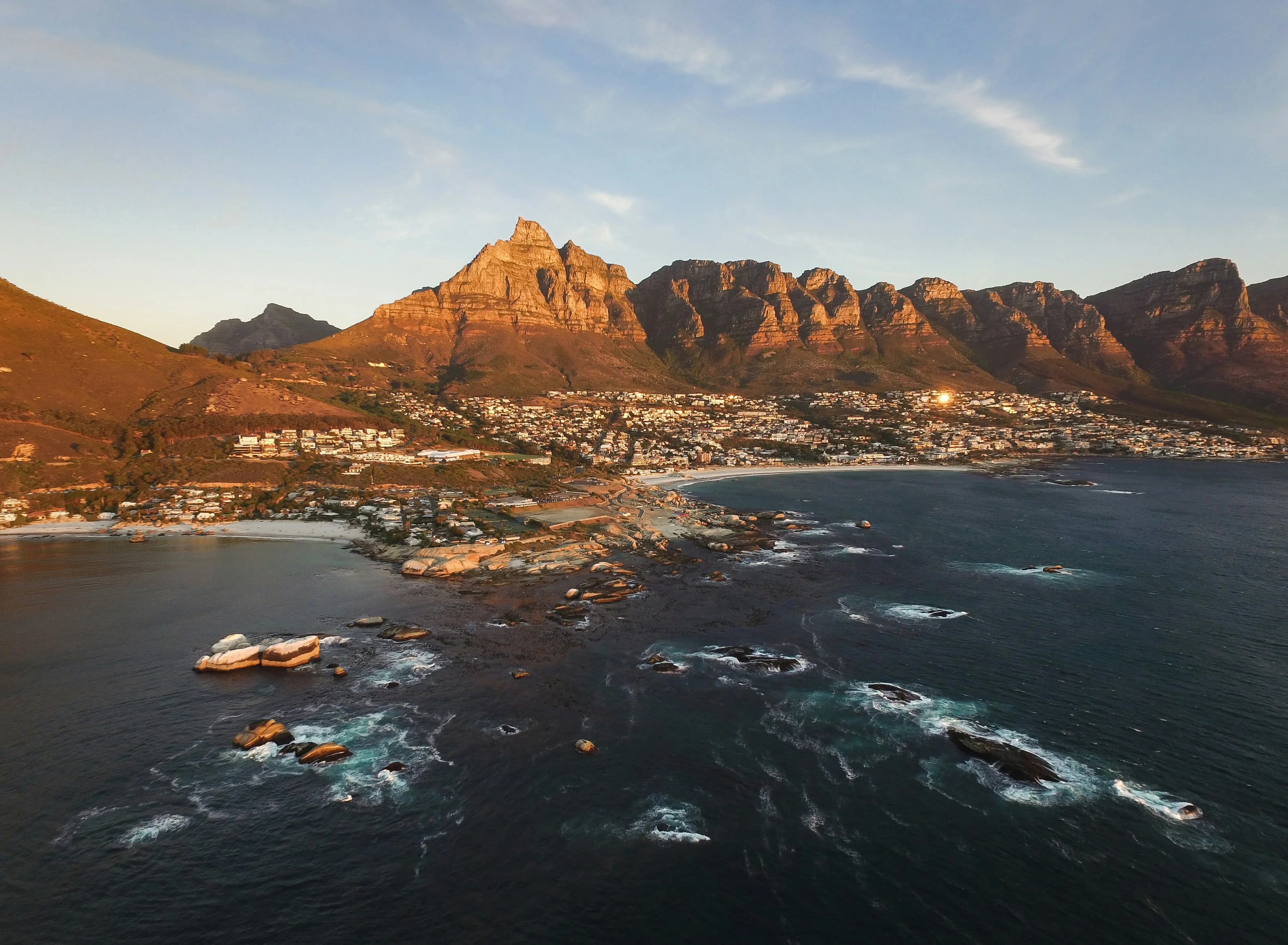
Cape Town: Sea Point, De Waterkant, and the slopes of Signal Hill Cape Town remains the architectural benchmark of the country. The Sea Point neighborhood, stretching along the Atlantic, offers direct views of the Table Mountain massif and concentrates several recent luxury properties, built with specific attention to solar orientation and visual transparency. De Waterkant, a former fishing quarter progressively rehabilitated, presents a tighter urban grid, ideal for boutique hotels of about ten rooms. The slopes of Signal Hill combine perceptual isolation with immediate proximity to the center — a balance sought by travelers who value city access without enduring its noise density.
Franschhoek and the Cape Winelands: The standard Less than an hour from Cape Town, the Franschhoek valley constitutes the densest gastronomic and viticultural hub in the country. The properties developed here over the past two decades rely on Cape Dutch architectural heritage—stepped gables, white lime, thatched roofs—which some establishments have managed to preserve without excessive museumification. Space here is generous: suites often boast private terraces opening directly onto the vineyards or the Drakenstein mountains. Stellenbosch, to the east, adopts a slightly more academic and urban tone, with a more diversified hotel offering in terms of scale.
Johannesburg: Sandton, Rosebank, and the Northern Suburbs Johannesburg is the economic capital of sub-Saharan Africa. Its luxury hotel offering is primarily concentrated in Sandton—a dense financial district, accessible from OR Tambo International Airport in less than forty minutes via the Gautrain. Sandton City serves as a premier commercial hub, and the surrounding hotels cater to a predominantly international corporate demand. Rosebank, on the other hand, offers a more relaxed atmosphere, with art galleries and independent restaurants attracting a more local leisure clientele. The Northern Suburbs—Melrose, Hyde Park—concentrate converted residential properties that capitalize on discretion and private square footage.
The Bushveld Lodges: Kruger, Sabi Sand, and Greater Limpopo The Sabi Sand Game Reserve, adjacent to the Kruger National Park, represents the global benchmark for luxury safari lodges. The properties located here are exclusively private, with controlled access, and boast some of the highest guide-to-guest ratios in the industry. The architecture is deliberately anchored in the landscape—wooden structures, thatched roofs, infinity pools facing watering holes frequented by wildlife. The Greater Kruger region, more accessible in terms of pricing, offers a comparable experience with less exclusive concessions. The Limpopo further north, as well as the private reserves of KwaZulu-Natal like Phinda or Thanda, diversify the geography of the premium safari without reaching the price points of Sabi Sand.
The Garden Route and Hermanus: Coastline and seasonality The Garden Route, between Mossel Bay and Storms River, concentrates a boutique offering geared toward high-end adventure tourism—diving, hiking in the Tsitsikamma, sea kayaking. Properties here are often small-scale, featuring organic architecture integrated into the forest or the coastline. Hermanus, on the coast of Walker Bay, is recognized as one of the best land-based whale-watching sites between June and November. The properties operating here leverage this strong seasonality to position short stays at premium rates.
When to stay in South Africa: Seasonality and benchmark events South Africa covers a vast enough area that climatic conditions vary significantly across regions. There is no universally optimal time to visit: the choice depends on the nature of the planned stay. Cape Town experiences an inverted Mediterranean climate: the austral summers (November to March) are hot and dry, with daytime temperatures between 25 and 32°C. The austral winter (June to August) is damp and windy, with temperatures rarely dropping below 10°C. The peak tourist season in Cape Town coincides with the austral summer, a period during which hotel rates reach their maximum and booking lead times are the longest. For safaris in the Lowveld and Kruger, the dry season (May to October) is recommended: sparse vegetation facilitates wildlife viewing, watering holes concentrate the animals, and daytime temperatures remain manageable (15 to 28°C). The wet season (November to April) sees denser vegetation and numerous animal births, which appeals to wildlife photographers—but roads can become impassable and some lodges temporarily close. Among the benchmark events for a high-net-worth travel clientele: the Cape Town Jazz Festival (March-April), which attracts an international audience and quickly saturates the quality hotel supply in the peninsula. The whale season in Hermanus (July to November) is a precise temporal window that structures the local offering. Design Indaba in Cape Town (February-March) is one of the most important design events on the African continent and attracts an international audience sensitive to contemporary aesthetics.
Local luxury standards in South Africa South Africa does not have an official classification equivalent to the French "Palace" label or the strict criteria of the British AA Five Star. The Tourism Grading Council of South Africa (TGCSA) administers a 1 to 5-star system, of which the highest tier—five stars—constitutes the benchmark for prestigious establishments. Several properties have additionally obtained distinctions within international collections: Relais & Châteaux, The Leading Hotels of the World, or Small Luxury Hotels of the World are the most frequent affiliations in the premium segment. For safari lodges, the most relevant distinction remains belonging to a private game reserve with controlled access and obtaining a Big Five access—a guarantee that the five iconic species (lion, leopard, elephant, rhino, buffalo) are present on the concession. This designation directly dictates the rates and reputation of the properties concerned.
How to choose the best suite in South Africa: Criteria and trade-offs Choosing a suite in South Africa involves several structural trade-offs that generalist booking tools cannot always resolve properly.
Private space versus landscape integration In the urban properties of Cape Town or Johannesburg, the square footage of the suite and the quality of acoustic insulation are determining criteria. In bush lodges, it is the orientation of the private terrace—its direct line of sight to a watering hole or the bush—that differentiates a suite from a standard room in terms of actual experience.
Exclusivity level and service ratio The most exclusive lodges in Sabi Sand operate with fewer than ten suites and maintain staff-to-guest ratios close to 1:1 or higher. This level of exclusivity comes at a cost—rates can exceed 3,000 USD per person per night in peak season—but it guarantees a quality of wildlife access and service personalization unmatched in higher-capacity properties.
Logistical accessibility Many high-end bush properties are only accessible by private plane or charter from Johannesburg or Hoedspruit. This logistical parameter must be integrated into the trip planning from the selection phase, as it can represent a significant portion of the total budget. Some properties offer transfers included in their nightly rate—an element to verify systematically.
Consistency between advertised aesthetics and architectural reality The South African hotel sector underwent an intense phase of renovation and repositioning between 2015 and 2023. Several properties displaying contemporary imagery in their marketing materials rely on partially renovated older structures. Verifying the dates of the latest suite renovations—and not of the establishment as a whole—is a step that La Suite's curation systematically integrates.
The value of curation in such a fragmented market South Africa counts several hundred establishments claiming to be luxury, with a particularly marked geographical dispersion and heterogeneity of standards. Generalist booking platforms list these establishments without real qualitative hierarchy, leaving the user with a volume of information that is difficult to process effectively. La Suite's curation relies on an evaluation process that takes into account the architectural integrity of the spaces, the consistency of pricing with the actual quality of the product, and the relevance of each property for specific traveler profiles. The 54 addresses listed for South Africa were selected because they meet explicit selection criteria—not because they subscribed to a commercial visibility program. This distinction determines the value of the selection.