


Morocco
Best Hotel Suites in Morocco
Morocco's geography determines the character of its luxury offer in ways that matter to the decision-making traveler. Each city and region functions as a distinct editorial category.
- Agafay6 hotels
- Aghouatim3 hotels
- Aït Faska1 hotel
- Alouidane5 hotels
- Asni1 hotel
- Casablanca2 hotels
- El Faid0 hotel
- Fezouane0 hotel
- Fnideq0 hotel
- Ghmate2 hotels
- Karia Ba Mohamed0 hotel
- Larache0 hotel
- M'Diq2 hotels
- Marrakech28 hotels
- Moulay Brahim1 hotel
- Ouahat Sidi Brahim1 hotel
- Ouled Hassoune2 hotels
- Ourika1 hotel
- Sidi Abdallah Ghiat3 hotels
- Souihla1 hotel
- Tameslouht7 hotels
- Tanger1 hotel
- Tassoultante7 hotels
Best Neighbourhoods and Districts for Luxury Suites in Morocco
Marrakech: The Medina vs. The Palmeraie
Marrakech divides cleanly between two luxury logics. The medina — specifically the neighborhoods of Mouassine, Bab Doukkala, and the streets immediately surrounding the Bahia Palace — is the territory of the converted riad. These are typically 16th-to-19th-century merchant houses restructured around a central courtyard, with suites occupying upper floors or detached garden pavilions. Light enters from above; noise from the street is absorbed by thick pisé walls. The spatial experience is deliberately inward-facing. The Palmeraie, by contrast, operates at a resort scale: larger land parcels, pool architecture, spa infrastructure, and a visual language borrowed in part from North African modernism. Travelers who require outdoor space and horizontal openness generally position here. Both zones carry a credible luxury offering; the choice is architectural rather than hierarchical.
Fès: The Oldest Medina in the World
Fès el-Bali — the original walled city founded in the 9th century — is a UNESCO World Heritage Site and functions as Morocco's most intact medieval urban environment. Luxury properties here are fewer in number and more demanding on the traveler: narrow alleys, absence of vehicle access, and sensory complexity that rewards patience. Suites in Fès tend toward scholarly restraint — zellij tilework, cedar-wood ceilings, mashrabiya screens — in properties that have taken their restoration seriously. This is a destination for travelers who read floor plans and care about provenance.
Essaouira: The Atlantic Coast
Essaouira's 18th-century Portuguese-Moroccan medina sits directly on the Atlantic, and its luxury positioning is anchored in wind, light, and the particular blue-and-white chromatic discipline of its architecture. Properties here are smaller in scale than Marrakech, the pace is slower, and the design vocabulary leans toward bleached wood, indigo textiles, and raw coastal materiality. It is a destination with a specific aesthetic logic — not aspirational in the conventional sense, but resolute in its register.
Agadir and the Souss-Massa Coast
Rebuilt after the 1960 earthquake, Agadir has a modernist urban structure unlike any other Moroccan city. Its luxury offer is resort-focused: beachfront properties, golf architecture, and purpose-built spa compounds. The design language is more international here, and the climate — stable sun, low humidity, Atlantic-tempered heat — makes it functional across a broader part of the year than inland cities.
The Saharan South: Merzouga and Zagora
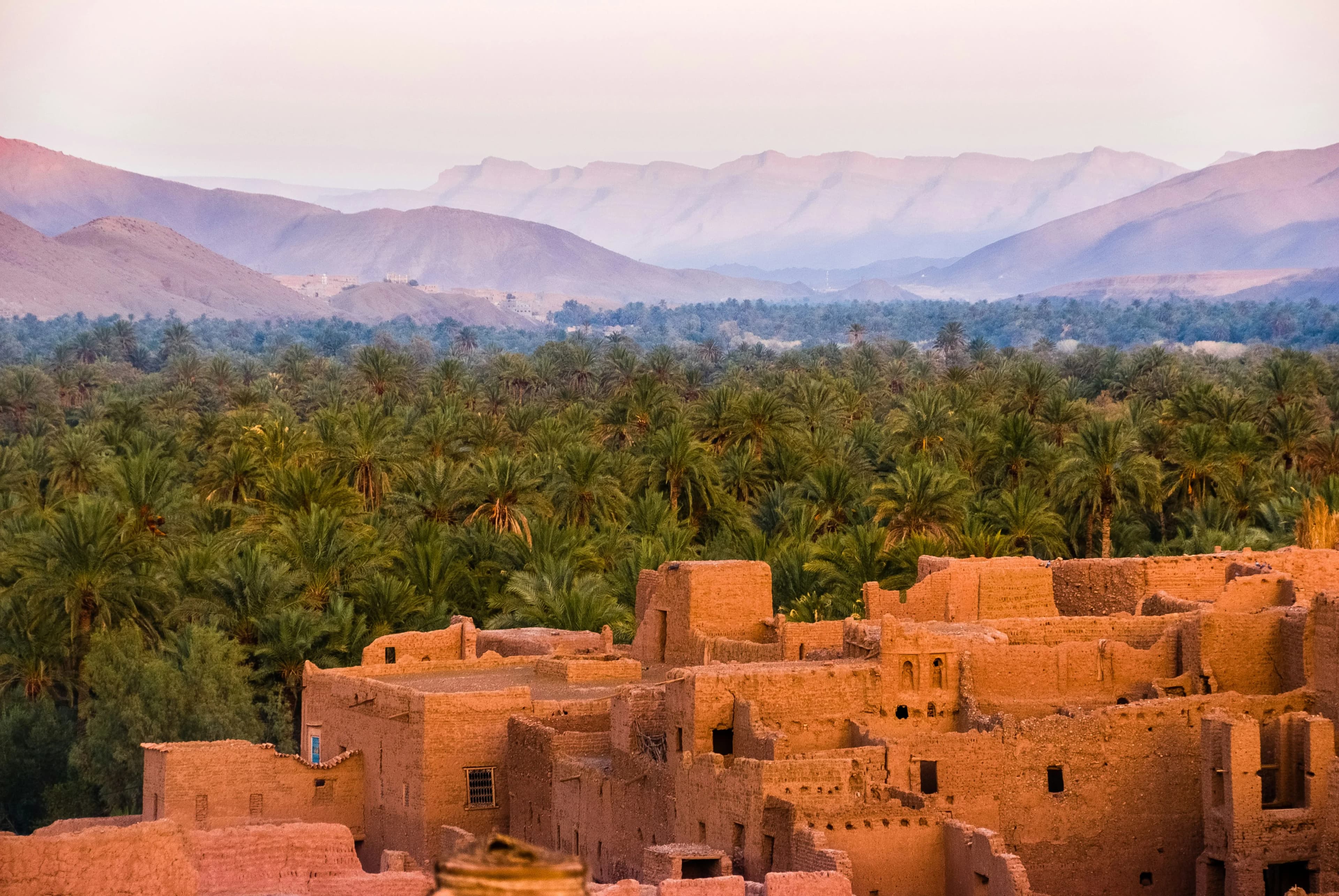
The desert approaches of southeastern Morocco — the Drâa Valley, the Tafilalet, the erg dunes near Merzouga — support a category of luxury that is deliberately remote. Properties here are often low-rise, earth-toned, and built to frame silence and astronomical darkness. The suite experience is inseparable from the landscape; the architecture is largely subservient to the setting. These are not properties for amenity maximalists.
When to Visit Morocco for Luxury Travel
Morocco's climate varies significantly by region, and travel timing affects both comfort and access in material ways.
Best Seasons by Region
For Marrakech, Fès, and inland cities, October through early December and March through May represent the most comfortable windows. Summer temperatures in Marrakech regularly exceed 40°C, which alters the utility of open-air courtyard architecture considerably. The Saharan south is best approached in autumn or early spring, when daytime temperatures are manageable and nights are cold enough to justify the architectural warmth of desert properties. The Atlantic coast — Essaouira, Agadir — is moderated year-round by ocean air, though Essaouira's wind can be persistent in summer months.
Key Events and Dates
The Marrakech International Film Festival (typically December) draws a significant international contingent and creates compression in the prime medina and Palmeraie properties. Ramadan — whose dates shift annually with the lunar calendar — changes the operational rhythm of most cities in ways that affect restaurant access and ambient noise patterns, though it also creates an atmospheric specificity that some travelers explicitly seek. The Gnaoua World Music Festival in Essaouira (June) is a significant cultural event that fills the city's limited hotel stock early.
Understanding Moroccan Luxury Classifications
Morocco does not operate a formal prestige designation equivalent to France's Palace category or the UK's Forbes five-star framework. The national hotel classification system uses a 1-to-5-star scale administered by the Ministry of Tourism, but this scale measures operational compliance rather than architectural or experiential distinction. A significant number of Morocco's most considered properties — particularly converted riads in medina environments — operate outside the conventional star matrix entirely, either through boutique classifications or through the Maison d'Hôtes designation, which applies to smaller guesthouses and private-house hotels.
What functions as a prestige signal in the Moroccan context is a combination of restoration integrity, craft authenticity, surface material quality, and — increasingly — landscape positioning. Properties that have invested in original zellij, hand-carved stucco, commissioned kilims, and sourced local artisanship across all touchpoints carry a different market weight than those with imported fixtures and cosmetic Moroccan detailing. The distinction matters and is legible on arrival.
How to Choose the Best Suite in Morocco
Courtyard Access and Suite Positioning
In riad properties, the relationship between a suite and the central courtyard is the primary architectural variable. Ground-floor rooms adjacent to the courtyard offer immediate outdoor access but receive less light and may carry more ambient noise from shared spaces. Upper-floor suites — often terraced, sometimes with private rooftop sections — offer elevation, light, and separation. The trade-off is vertical rather than horizontal distance. Clarify this geography before booking.
Pool Architecture
Many medina properties have retrofitted plunge pools or lap pools into courtyard footprints. The quality of this integration varies: some are elegantly solved; others compromise the spatial coherence of the original structure. In Palmeraie and resort properties, pool scale is more predictable. If pool use is a primary criterion, assess the specific configuration of the property rather than relying on category assumptions.
Hammam Access
A private in-suite hammam is a material differentiator in the Moroccan luxury context. Many properties offer hammam facilities at the property level, but the distinction between a shared spa hammam and a suite-integrated one is significant for travelers who prioritize privacy and schedule flexibility.
Noise Environment
Medina properties sit within dense urban fabric. Morning calls to prayer, market activity, and foot traffic are environmental constants. This is not a defect — it is a condition of the setting — but travelers with specific noise sensitivity should understand that even high-specification medina suites operate within an ambient sound environment that no amount of wall thickness fully eliminates.
Why Curation Matters in the Moroccan Hotel Market
Morocco has one of the most opaque luxury hotel markets of any major travel destination. The sheer volume of riad conversions — particularly in Marrakech, where the category expanded rapidly through the 2000s and 2010s — means that the market contains extraordinary range in quality beneath a superficially consistent aesthetic surface. Properties that photograph identically may differ substantially in restoration quality, suite materiality, service infrastructure, and operational reliability.
La Suite's selection of 84 properties across Morocco represents editorial filtering across those variables: architecture, craft integrity, spatial experience, and the specific quality of the suite offering rather than the property in aggregate. In a market where the signal-to-noise ratio is low and where visual presentation has historically outpaced product reality, a curated selection functions as a practical instrument. It collapses a research process that would otherwise require significant specialist knowledge into a set of verified, considered options. Curated selection by La Suite.