


China
Luxury Hotel Suites in China
China's hotel geography is not uniform. The character of a suite experience is determined significantly by its district, and understanding those districts is the first act of a considered stay.
Baoshan
1 hotel
Canton
11 hotels
Changsha
1 hotel
Changzhou
1 hotel
Chaozhou
3 hotels
Chengdu
6 hotels
Chongqing
6 hotels
Dalian
1 hotel
Foshan
7 hotels
Guilin
4 hotels
Hangzhou
11 hotels
Harbin
2 hotels
Hefei
1 hotel
Hohhot
1 hotel
Huangshan
1 hotel
Jinzhong
1 hotel
Kaifeng
1 hotel
Kunming
3 hotels
Leshan
2 hotels
Lijiang
6 hotels
Nankin
5 hotels
Ningbo
2 hotels
Pékin
17 hotels
préfecture autonome bai de Dali
1 hotel
préfecture autonome hani et yi de Honghe
1 hotel
préfecture autonome tibétaine de Dêqên
5 hotels
Préfecture autonome tibétaine et qiang d'Aba
7 hotels
Qingdao
3 hotels
Qinhuangdao
1 hotel
Sanya
2 hotels
Shanghai
25 hotels
Shaoxing
10 hotels
Shenzhen
17 hotels
Suzhou
11 hotels
Ürümqi
1 hotel
Wuhan
2 hotels
Wuxi
4 hotels
Xi'an
2 hotels
Xiamen
4 hotels
Xuancheng
3 hotels
Yangzhou
1 hotel
Zhangjiajie
1 hotel
Zhengzhou
1 hotel
Zhongwei
1 hotel
Zhoushan
1 hotel
Zhuhai
3 hotels
Best Neighbourhoods for Luxury Hotel Suites in China
Wangfujing and the Imperial Core, Beijing
Beijing's central axis — anchored by the Forbidden City and Tiananmen Square — draws properties that operate as architectural counterparts to the imperial scale surrounding them. Wangfujing, the traditional commercial spine running north of Chang'an Avenue, hosts several of the city's most formal luxury addresses. The streets here operate under an almost ceremonial stillness compared to other capital cities at comparable density. Suites in this zone command direct sightlines toward the city's defining monuments and position guests within walking distance of major cultural institutions including the National Museum of China.
The Bund and Lujiazui, Shanghai
The Bund remains Shanghai's most legible luxury address — a 1.5-kilometre waterfront of early-twentieth-century European commercial architecture facing the Pudong financial district. Properties here occupy former banking houses and trading headquarters, offering suites with a distinctly historical material vocabulary: marble, brass, coffered ceilings. Across the Huangpu River, Lujiazui in Pudong operates in an entirely different register: vertical, contemporary, and orientated toward the financial architecture of the twenty-first century. Both districts serve different traveler profiles and should not be treated interchangeably.
The French Concession, Shanghai
For guests prioritising residential texture over monument proximity, the former French Concession offers a quieter spatial logic. Tree-lined avenues, low-rise lane house architecture, and a density of independent design institutions define the district. Boutique-scale luxury properties here typically convert heritage lane houses into suite configurations with private courtyard access, placing guests within Shanghai's most design-literate neighbourhood.
Sanlitun and Chaoyang, Beijing
Beijing's contemporary cultural infrastructure concentrates in Chaoyang, with Sanlitun functioning as its commercial and lifestyle focal point. This district is the appropriate base for guests whose itinerary centres on contemporary art — the 798 Art District lies within easy reach — or business conducted at the Central Business District. Hotels here tend toward the contemporary international idiom rather than the culturally specific aesthetic found closer to the imperial core.
West Lake District, Hangzhou
Hangzhou operates as China's pre-eminent leisure destination for the domestic luxury traveler. West Lake — a UNESCO World Heritage Cultural Landscape — organises the city's hotel geography entirely. Suites with lake-facing orientations are the defining product here, with properties designed around the prospect of mist, pagodas, and water at different hours of the day. The experience is meditative rather than urban.
Yuzhong and Jiangbei, Chongqing
Chongqing's vertical topography — the city is built across hillsides at the confluence of the Yangtze and Jialing rivers — produces hotel experiences unavailable elsewhere in China. Suites on elevated floors command river panoramas of unusual drama. The Yuzhong Peninsula remains the historic commercial and administrative core, while Jiangbei has emerged as the contemporary luxury district.
When to Visit China for a Luxury Suite Stay
China's geographic scale means there is no single optimal travel season applicable to the whole country. The decision requires specificity by destination.
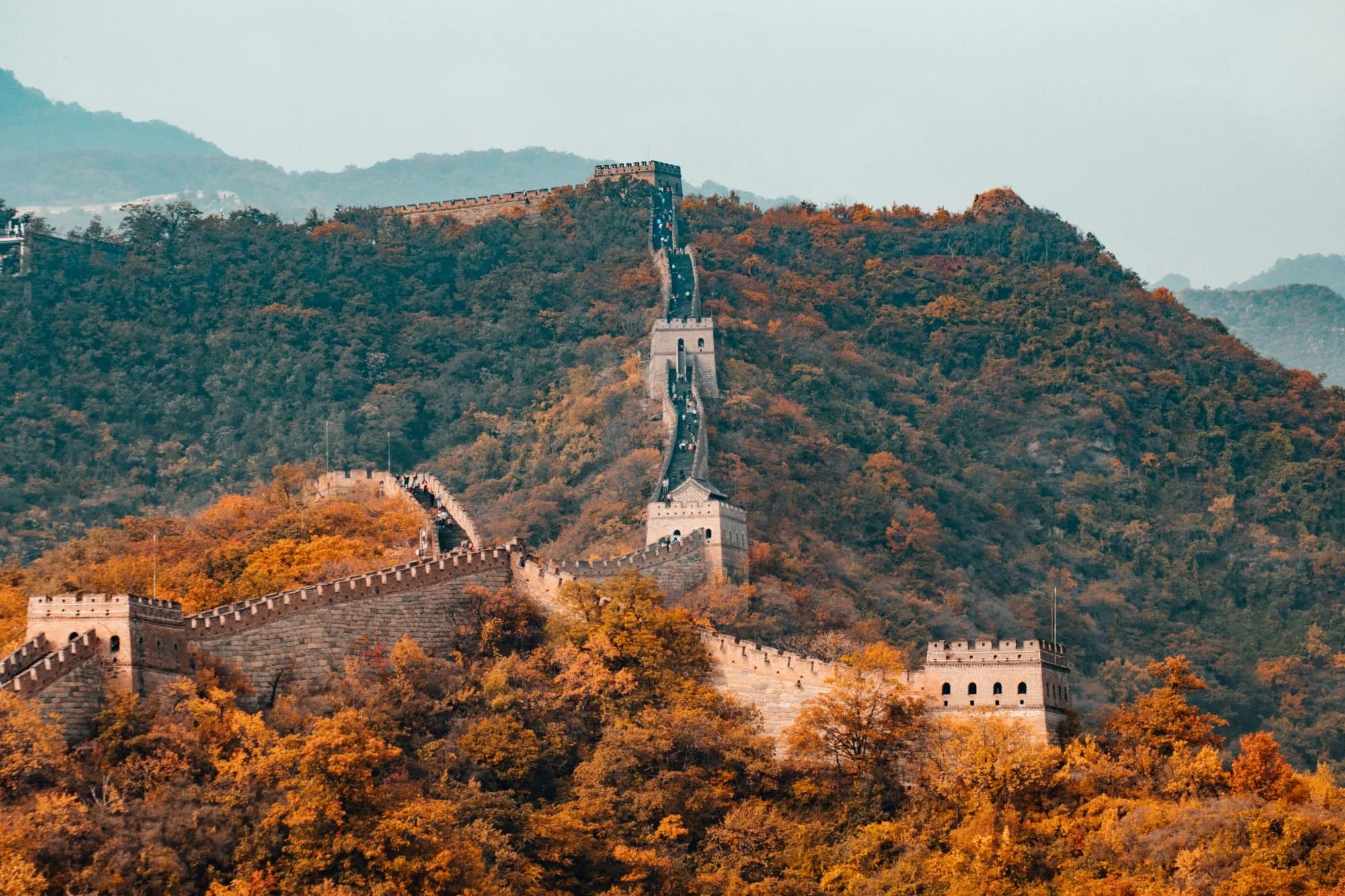
For Beijing and Northern China, the optimal windows are late spring — April through early June — and autumn from September through October. These shoulder seasons offer moderate temperatures and the clearest air quality. Summer in Beijing is humid and dense with domestic tourism; winter, while culturally interesting around the Lunar New Year period, is cold enough to restrict outdoor itineraries.
Shanghai's most comfortable periods align broadly with Beijing: April to May and September to November. The July to August period brings high humidity and frequent rain from the plum rain season. Shanghai's calendar of design, art, and fashion events concentrates in autumn, making October particularly active for culturally oriented visits.
Hangzhou and the Yangtze Delta region are at their most iconic in spring, when West Lake is bordered by flowering plum and cherry trees, and again in late October when autumn foliage defines the landscape. The West Lake Longjing tea harvest in March and April draws a specific category of informed traveler.
Chengdu and Southwest China operate on a different climatic logic — the Sichuan Basin has its own microclimate, with relatively mild winters and overcast summers. Spring and autumn are the preferred entry points.
The Lunar New Year period — typically falling between late January and mid-February — requires particular planning. Domestic travel demand compresses suite availability significantly and should be anticipated well in advance. Conversely, it represents one of the most culturally dense periods to be in a major Chinese city.
Understanding Luxury Standards in China's Hotel Market
China does not operate a direct equivalent of France's Palace designation or the UK's AA Five Red Stars system. The national standard is administered through the China National Tourism Administration (CNTA) using a star classification system, with five stars representing the formal ceiling. However, the five-star designation covers a wide range of properties and should not be used as the primary selection criterion.
The more reliable markers of true luxury positioning in China are brand affiliation with the established international groups — Aman, Rosewood, Four Seasons, Mandarin Oriental, Capella — and, increasingly, the major Chinese luxury operators such as Shangri-La (Hong Kong-headquartered, operating extensively in Mainland China) and the Peninsula Hotels. Homegrown luxury hospitality brands including Nuo Hotel and the Bvlgari properties developed with local partners are raising the standard of the domestic market.
Heritage designations matter. Properties operating within classified historic structures — former banking houses, colonial-era hotels, or traditional hutong courtyard compounds — carry a spatial authenticity that new-build towers cannot replicate. The Shing Hotel classification for historic properties is a reference point, though verification of authentic restoration quality, rather than superficial period styling, remains essential.
How to Choose the Best Suite in China: Practical Considerations
The geographic scale of China is the primary practical factor. China spans five time zones and contains hotel markets as differentiated as Beijing, Lhasa, and Sanya. Selecting a suite without first anchoring the itinerary geographically is an inefficient approach.
Floor orientation matters considerably in China's major cities. In Shanghai's Pudong towers, even-numbered floors on certain elevations can face directly into adjacent tower facades; west-facing rooms in Beijing can deliver unobstructed sunset views across the city's low-rise historic core. These specifics are worth confirming directly.
Service language is a practical consideration. While major luxury properties in Beijing and Shanghai maintain English-speaking concierge teams, this cannot be assumed at properties in secondary cities. The quality of the concierge function — its network reach, its ability to facilitate access to closed or restricted cultural sites — is a meaningful differentiator at this market level.
Suite size in China's luxury segment tends toward the generous, particularly in newer properties where floor plate economics favoured large room dimensions. However, ceiling height and natural light — both affected by dense urban plot ratios — are more variable, and should be assessed on a property-by-property basis.
The Value of a Curated Selection in the Chinese Market
With 163 properties reviewed and indexed by La Suite, the Chinese market represents one of the most complex luxury hotel geographies in the world. The volume of new-build hotels entering the five-star category annually, combined with the pace of renovation among legacy properties, creates a landscape that is difficult to navigate without structured criteria.
Curation in this context is a filtering function. It eliminates properties that meet nominal luxury criteria — branded affiliation, room count, lobby size — but fail on the experiential specifics that define the category: suite proportions, material quality, the coherence of the spatial design programme, and the actual delivery of service against its stated standard.
La Suite's selection applies a consistent framework across all 163 Chinese properties, enabling direct comparison across cities and property types. For a traveler moving between Beijing and Shanghai on a single itinerary, this comparative structure identifies which properties operate at equivalent standards rather than equivalent price points — a distinction that matters.
Frequently Asked Questions: Luxury Hotel Suites in China
What is the best area to stay in Beijing for a luxury suite?
The area around Wangfujing and the Imperial Core offers the closest proximity to Beijing's major cultural and historical monuments, with several of the city's most formal luxury properties. Chaoyang is the preferred district for contemporary design hotels and business-oriented stays.
What is the best time of year to book a luxury suite in Shanghai?
April to May and September to November represent the optimal windows, offering moderate temperatures and alignment with Shanghai's major cultural and design programming calendar. The July to August period brings peak humidity and reduced appeal for outdoor itineraries.