


India
Best Hotel Suites in India
India's geography demands specificity. The decision of where to stay is inseparable from the decision of where to go — each region operates according to its own architectural logic, climate, and cultural register.
Agra
1 hotel
Ahmedabad
1 hotel
Badgaon tehsil
2 hotels
Bali
1 hotel
Bangalore
2 hotels
Bénarès
2 hotels
Bombay
3 hotels
Calcutta
2 hotels
Dehradun
3 hotels
Devanahalli
1 hotel
Dhanaulti
3 hotels
district de Patiala
1 hotel
Gangtok
1 hotel
Haridwar
2 hotels
Indore
1 hotel
Jaipur
8 hotels
Jaisalmer
1 hotel
Jodhpur
1 hotel
Kullu
1 hotel
Kundapura
1 hotel
Kurseong
1 hotel
Madras
1 hotel
Manali
1 hotel
Mapusa
2 hotels
Narendra Nagar
1 hotel
New Delhi
1 hotel
Pawkidevi
1 hotel
Pune
1 hotel
Rajarhat Gopalpur
1 hotel
Samudrapur
1 hotel
Sawai Madhopur
1 hotel
Shamirpet
1 hotel
Solan
1 hotel
Tehla
1 hotel
Udaipur
5 hotels
Best Neighbourhoods and Districts for Hotel Suites in India
Udaipur, Rajasthan
Udaipur is perhaps India's most formally composed destination for suite travel. Built around Lake Pichola, the city is defined by white marble architecture, formal gardens, and a preserved palatial scale that few destinations on earth can match. The Aravalli hills frame the lake on multiple sides, creating a contained, almost theatrical urban form. Properties here are former royal residences, and the suites within them occupy ceremonial rooms — durbars, zenanas, and tower chambers — with proportions that reflect their original function. The city operates at a slower, more deliberate pace, suited to immersive stays rather than transitory visits.
Jaipur, Rajasthan
The Pink City carries a different energy — more mercantile, more layered. Jaipur's walled old city contains some of the subcontinent's most intact examples of Rajput civic architecture. Suite properties here tend to occupy havelis and small palaces within or adjacent to the old city, offering proximity to its bazaars, temples, and gardens. The Rambagh area, south of the walled city, hosts several of the larger palace conversions operating as full-service luxury hotels.
Mumbai
Mumbai's suite market is concentrated along the western waterfront — Marine Drive, Nariman Point, and the older Colaba precinct — and in the newer commercial districts of Bandra-Kurla Complex and Lower Parel. The city's top suites are predominantly vertical: high-floor rooms in contemporary towers with unobstructed views of Back Bay or the Arabian Sea. Mumbai also carries the Taj Mahal Palace, a heritage property at Apollo Bunder whose suites in the Heritage Wing occupy some of the most historically significant hotel rooms in South Asia.
Delhi
New Delhi's suite geography divides along Lutyens' original city plan. The central Lutyens zone — Chanakyapuri, Diplomatic Enclave, and the area around Rajpath — contains the city's established grand hotels, most of them operating across large, low-rise campuses with significant green space. South Delhi's Mehrauli corridor and the Golf Course Road area in adjacent Gurugram have added contemporary properties to the market. Old Delhi, by contrast, remains largely outside the formal luxury hotel circuit, functioning instead as a destination reached from a base elsewhere.
Kerala
Kerala's suite market operates at a different register entirely. Properties here are dispersed across the backwaters of Alleppey, the hill stations of Munnar, and the coastal strip between Kovalam and Varkala. The architectural language is vernacular — teak, laterite, sloped Mangalore tile roofs — and many properties are smaller, more intimate, and oriented around landscape and therapeutic programming. Kerala is particularly associated with Ayurvedic wellness, and a number of suite properties here are integrated with dedicated medical Ayurveda facilities rather than spa amenities.
Agra and the Golden Triangle
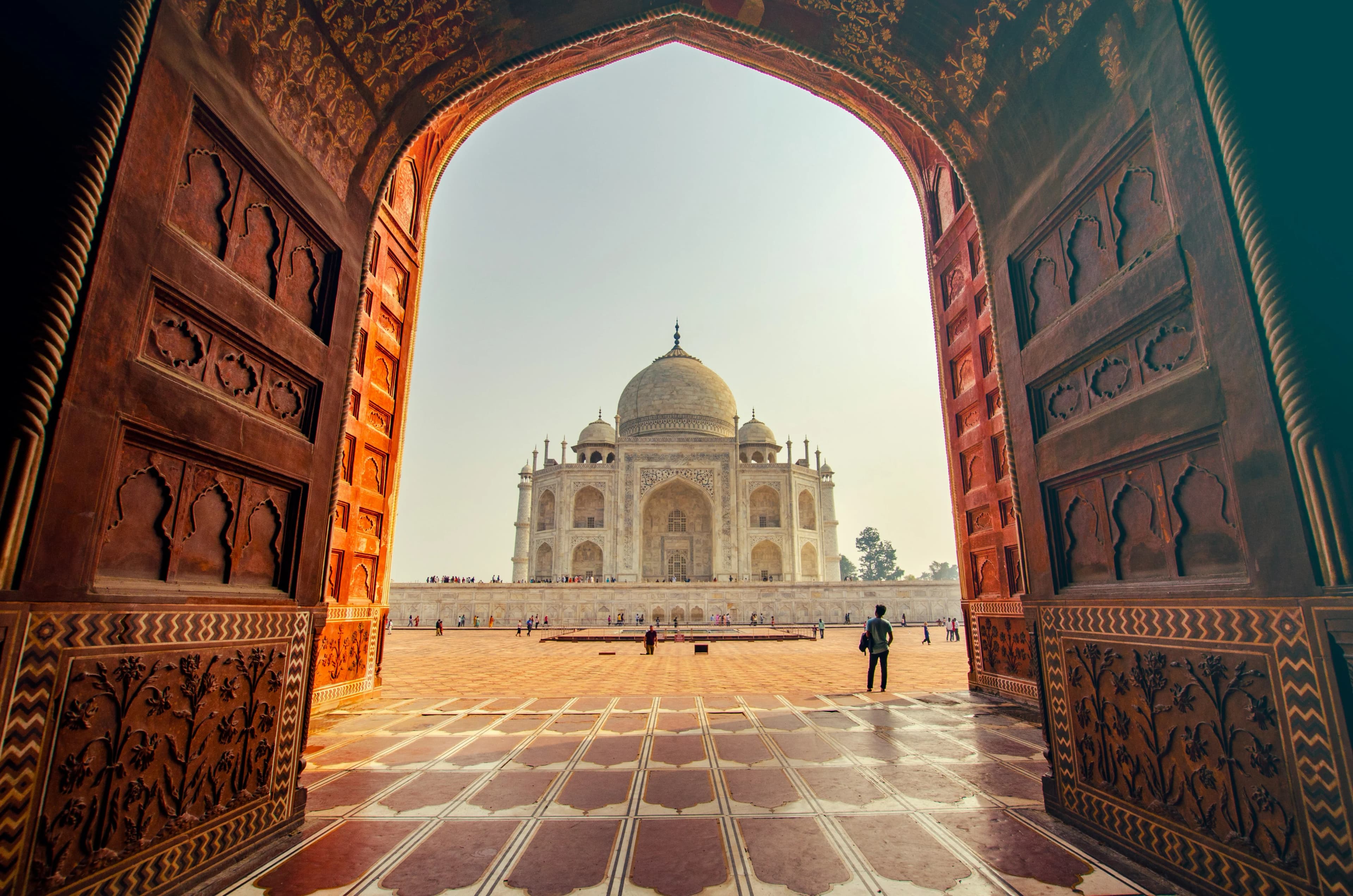
Agra's hospitality market exists almost entirely in relation to the Taj Mahal. The most considered suite properties are those offering a direct sightline to the monument — a geographical specificity that concentrates value into a narrow band of real estate east of the Yamuna riverbank. The Golden Triangle circuit (Delhi–Agra–Jaipur) remains the country's most heavily travelled luxury itinerary and is served by a well-established network of top-tier properties at each node.
When to Visit India for a Suite Stay
India's scale means that no single travel season applies uniformly across the country. Climate is determinative, and the decision of when to travel should precede the decision of where.
The canonical high season for Rajasthan, Delhi, Agra, and the north is October through March. Temperatures in this window are moderate — rarely exceeding 25°C in the core months of November and February — and the light is clear and direct, particularly valuable for those travelling with a visual or photographic agenda. The period from December through January coincides with peak hotel occupancy and highest rates across the northern circuit.
Mumbai operates year-round but its most comfortable window runs from November through February. The monsoon, which arrives in June and persists through September, transforms the city but also brings a particular atmospheric intensity that some travellers actively seek.
Kerala's climate follows the opposite logic: the southwest monsoon arrives earlier here (typically June) and the shoulder seasons of March–April and October–November offer the most workable conditions for combined coastal and backwater itineraries.
Jaipur's Literature Festival, held annually in late January, is one of the subcontinent's most significant cultural events and consistently drives occupancy across Rajasthan's top properties. The Pushkar Camel Fair in November, while less formal, draws a specific international audience to the region.
Understanding Luxury Hotel Standards in India
India does not operate a government-administered prestige classification equivalent to France's Palace designation or Thailand's formal luxury tier certification. The five-star system administered by the Ministry of Tourism provides a baseline but does not distinguish meaningfully at the upper end of the market.
The most reliable market signals for suite quality in India are brand affiliation, heritage status, and legacy.
The Taj Hotels group, through its Taj and SeleQtions brands, operates several of the country's most significant historic properties and applies a consistent standard of service across its portfolio. The Oberoi Hotels and Resorts group — through Oberoi and Trident — is regarded within the industry as operating among the tightest service standards in Asia. IHCL's Taj properties, particularly those in the Taj Palace and Taj Lake Palace category, represent the heritage tier. Leela Palaces occupies a parallel position with a more contemporary design language.
The category of heritage hotels — properties converted from royal residences, havelis, and forts — is formalised by the Indian government's Heritage Hotels Association, which classifies properties as Grand Heritage, Classic Heritage, or Heritage Basic depending on the age of the structure and the extent of preservation. This classification is informative but not sufficient on its own: the quality of the suite experience within a heritage property depends heavily on the investment in restoration and the operating standards of the management.
International brands — Aman, Four Seasons, St. Regis, Rosewood, and Raffles — are present in Mumbai and Delhi and bring consistent global standards to the urban market. Aman's presence at the Lodhi in Delhi represents perhaps the clearest application of a global luxury framework to an Indian context.
How to Choose the Best Suite in India
The first variable to resolve is the type of experience sought. India's suite market bifurcates sharply between heritage and contemporary. A suite in a converted Rajput palace delivers spatial character, cultural density, and architectural singularity. A suite in a contemporary tower delivers predictability, technical specification, and views. The two are rarely substitutable for each other, and the decision between them is a matter of preference rather than quality.
For heritage properties, ask specifically whether the suite offered is in the original structure or a later extension. Many palace hotels have expanded through modern wings, and the character differential between a room in the original zenana and one in a new block can be significant. The most considered suites in heritage properties — the ones that justify premium pricing — tend to be those directly converted from ceremonial or royal private spaces: tower rooms, corner suites in historic walls, or rooms with named histories.
For contemporary properties, floor and orientation matter more than they might in other markets. In Mumbai, a suite facing Back Bay versus one facing the city interior is a materially different product. In Agra, the Taj Mahal view is not incidental — it is architecturally constitutive of the suite's value.
Practical considerations: tipping culture in India is active across all service touchpoints, and budgeting for this is practical. Visa processing for India has become more streamlined with the e-Visa system, though lead time is advised for premium travel windows. Direct flights to Mumbai and Delhi from London and New York are well-served; secondary destinations (Udaipur, Jaipur, Kochi) require a domestic connection, typically via one of the two main hubs.
Why a Curated Selection Matters in India
India's hotel market is one of the largest and most heterogeneous in the world. The country's five-star inventory alone runs into hundreds of properties, and the heritage hotel category adds several hundred more. Navigating this market without a framework for quality assessment produces inconsistent results — the gap between a property that presents well in photography and one that delivers at the level of a serious suite stay can be significant.
La Suite's selection of 54 properties across India reflects a deliberate filtering process that prioritises suite-specific quality: spatial dimensions, design coherence, bathroom specification, view composition, and the service standard applied to private and in-suite interaction. The selection is not exhaustive; it is precise. It answers the question of which properties consistently meet the criteria that matter to design-literate, experience-driven travellers, without requiring that traveller to audit the full market themselves.
Frequently Asked Questions About Hotel Suites in India
What is the difference between a palace hotel and a heritage hotel in India?
A palace hotel is a property that was originally built as a royal residence — typically by a maharaja or nawab — and has been converted for hospitality use. A heritage hotel is a broader classification that includes palaces but also forts, havelis, colonial bungalows, and other historic structures. All palace hotels are heritage hotels, but not all heritage hotels are palaces.
Are heritage hotel suites in India structurally authentic or heavily renovated?
This varies significantly by property. The best operators preserve original walls, floors, and architectural detailing while introducing modern plumbing, climate control, and electrical systems discreetly. Some properties have undertaken more invasive renovations that compromise the original character. Verifying the provenance of specific rooms before booking is advisable for travellers for whom architectural authenticity is a primary criterion.
Which Indian city has the highest concentration of top-tier hotel suites?
Mumbai and Delhi carry the largest number of internationally branded luxury suite properties. Udaipur, while a smaller city, has a higher density of formally exceptional heritage suites relative to its overall hotel inventory and is frequently cited by industry professionals as India's most distinctive suite destination.