


Japan
Luxury Hotel Suites in Japan
Japan's geography of luxury is not uniform. Each city — and each district within it — carries a distinct spatial logic that directly shapes the quality and character of its hotel suites.
Best Neighbourhoods for Luxury Suites in Japan
Marunouchi and Ginza, Tokyo
These two adjacent districts form Tokyo's institutional core. Marunouchi sits directly opposite the Imperial Palace grounds and has been systematically redeveloped since the late 1990s into a dense corridor of corporate architecture, flagship retail, and formal dining. Hotels here address a clientele that values proximity to financial and governmental infrastructure. Ginza, immediately south, functions as Japan's most regulated luxury retail environment — zoning laws, height restrictions, and facade standards give the district an unusual coherence. Suites in Ginza benefit from this controlled aesthetic environment and tend to occupy mid-to-upper floors of purpose-built towers with clear sightlines across the district.
Minami-Aoyama and Omotesando, Tokyo
This axis is Tokyo's architectural statement district. The Omotesando boulevard, often described as Tokyo's answer to the Champs-Élysées, is lined with flagship buildings by Tadao Ando, Herzog & de Meuron, and SANAA. Minami-Aoyama, immediately west, is quieter, gallery-dense, and preferred by a design-literate residential demographic. Hotels positioned in or near this corridor tend toward restrained interiors, smaller room counts, and a curatorial approach to materials — stone, oak, lacquer — that reflects the neighbourhood's sensibility.
Higashiyama, Kyoto
Higashiyama is Kyoto's most architecturally preserved district, running along the eastern foothills toward Gion. The area contains several of the city's most significant temples and maintains a street-level character — machiya townhouses, stone-paved lanes — that has been actively protected from commercial redevelopment. Luxury accommodation here takes the form of converted townhouses, intimate ryokan, and small boutique properties. The experience of staying in Higashiyama is fundamentally different from a tower hotel: spatial compression, garden orientation, and material intimacy define the offer.
Gion, Kyoto
Kyoto's Gion district is internationally recognised as the city's cultural and ceremonial heart. It functions as a controlled preservation zone — new construction is heavily regulated, signage is restricted, and the geisha district of Hanamikoji maintains strict operational protocols. Hotels and ryokan operating here benefit from immediate access to the district's cultural calendar while operating within one of Japan's most visually disciplined urban environments.
Nishi-Azabu and Hiroo, Tokyo
These residential neighbourhoods in Minato ward represent Tokyo's quietest luxury register. Large embassies, private gardens, and low-rise residential blocks characterise both areas. Hotels here are typically small in scale and appeal to travellers seeking a residential quality — discretion over spectacle. The area is within walking distance of Roppongi's cultural institutions, including the Mori Art Museum and the National Art Center.
Hakone and the Fuji-Hakone Region
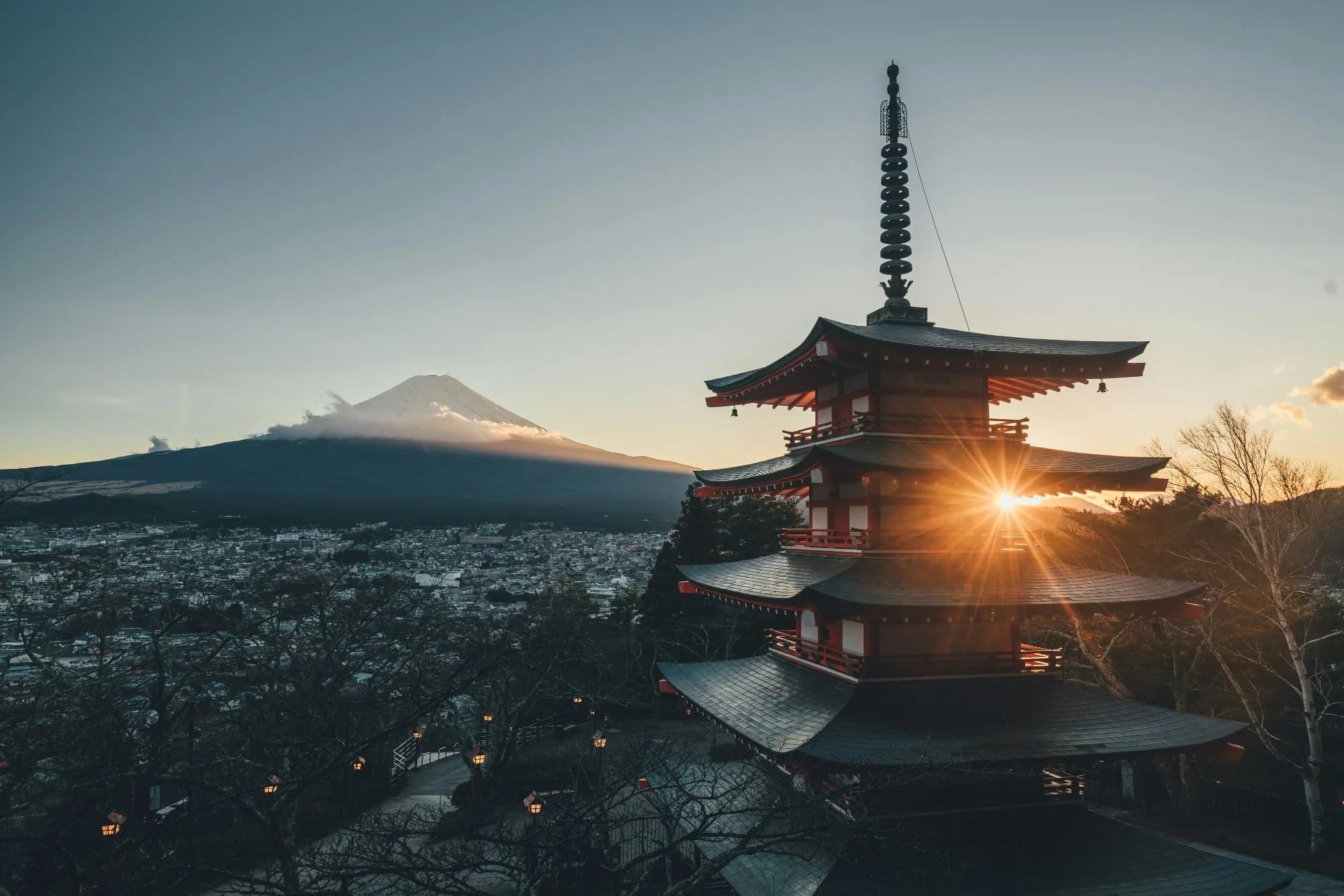
Approximately 90 kilometres southwest of Tokyo, the Hakone region offers an alternative spatial logic entirely: mountain topography, onsen (geothermal hot spring) access, and views of Mount Fuji on clear days. Luxury properties here are typically low-rise, landscape-integrated structures. The design language is consistently rooted in natural material — cedar, stone, washi paper — and the programmatic emphasis is on thermal bathing, seasonal cuisine, and spatial decompression. This is Japan's most established luxury escape corridor from Tokyo.
When to Visit Japan for a Luxury Stay
Japan has four well-defined seasons, each carrying cultural weight and directly affecting the hotel experience.
Spring: Late March to Early May
Cherry blossom season — sakura — remains Japan's most internationally recognised natural event. The bloom typically begins in late March in Tokyo and progresses northward through April. Kyoto's bloom peaks approximately one week after Tokyo's. This period sees the highest international demand and correspondingly elevated room rates. Properties with garden access or elevated positions overlooking parks command significant premiums. Advance planning of four to six months is standard for prime properties during this window.
Autumn: Mid-October to Late November
The autumn foliage season — koyo — is widely considered Japan's most atmospheric period for travel. Maple and ginkgo trees transition across a sustained six-week window, with Kyoto's temple gardens and Tokyo's Shinjuku Gyoen and Rikugien parks serving as primary viewing sites. Hotel demand during peak koyo weeks approaches cherry blossom levels. This is generally regarded as the optimal season for combining urban luxury with natural landscape.
Summer: June to August
June marks the beginning of the rainy season (tsuyu), which typically runs through mid-July. August is hot and humid across most of the country. This period sees lower international demand outside of major festival weeks — Kyoto's Gion Matsuri in July being the principal exception, which drives a significant spike in accommodation demand across the city. Summer is, paradoxically, one of the more cost-efficient periods for accessing premium properties in secondary cities.
Winter: December to February
Tokyo winters are dry and relatively mild. Kyoto winters are colder, with occasional snow that significantly transforms the visual quality of temple and garden environments. Hakone and mountain ryokan in the Tohoku and Hokkaido regions shift to their primary season during winter, with onsen bathing and snow landscape experiences driving demand. Hokkaido's Niseko area, in particular, has developed a high-density luxury ski and onsen market heavily shaped by Australian and Southeast Asian investment.
Understanding Japan's Luxury Hotel Standards
Japan does not operate within the European five-star classification framework in any codified national sense. Quality signals are expressed through a distinct local vocabulary.
Ryokan Classification and the Onsen Mark
Ryokan — traditional Japanese inns — operate under a classification system administered by the Japan Ryokan Association and regional tourism bodies. The highest-tier designation, often referred to informally as rokan or referenced through Japan Tourism Agency quality standards, identifies properties that meet strict criteria for architectural integrity, kaiseki cuisine quality, hot spring access, and service protocol. Properties carrying onsen certification are verified for geothermal mineral content and source.
The Role of Michelin in Japan's Hospitality Landscape
Japan has more Michelin-starred restaurants than any country in the world, and hotel restaurants within Japan's top properties frequently hold one or more stars. This is a meaningful quality signal for suite selection: properties with recognised in-house dining typically demonstrate equivalent standards across all service dimensions.
Leading Hotels of the World and Forbes Travel Guide
A number of Japan's premium urban properties carry Forbes Travel Guide Five-Star or Leading Hotels of the World designations. These provide internationally legible quality benchmarks and are particularly relevant for travellers calibrating Japan's luxury offer against European or American reference points.
How to Choose the Right Suite in Japan
The decision framework for selecting a luxury suite in Japan differs meaningfully from other markets because the country offers two architecturally distinct hospitality traditions — Western hotel and ryokan — which are not interchangeable in their spatial and experiential logic.
A Western-format suite in a Tokyo tower hotel provides spatial familiarity: elevated floor, city view, European bathroom fixtures, formal concierge infrastructure. A ryokan suite — particularly a private-villa or detached structure — provides tatami flooring, futon bedding, in-room kaiseki service, private rotenburo (outdoor onsen bath), and a daily rhythm structured around bathing and seasonal cuisine. These are fundamentally different residential experiences and should be selected according to the traveller's specific intent.
For multi-city itineraries, the standard curatorial approach is to combine one urban tower property — typically Tokyo — with one ryokan stay, either in Kyoto, Hakone, or Kyushu's Beppu region. This pairing allows direct engagement with both registers of Japanese luxury within a single trip.
Practical considerations: many premium ryokan require guests to commit to a dinner-and-breakfast meal plan (these kaiseki meals are integral to the property's identity and economics). Room counts at top ryokan are often below twenty, meaning availability during peak seasons is structurally constrained. Direct booking or specialist curation is the most reliable access route.
The Value of a Curated Selection in Japan
Japan's luxury hotel market contains significant variance in quality, pricing, and suitability for international travellers. The country's 43 properties identified by La Suite represent a filtered view of this market — prioritising architectural coherence, verifiable service standards, and spatial quality over marketing classification alone.
The principal challenge for first-time visitors is navigating a market where quality signals are often expressed in Japanese-language frameworks, where the most respected properties do not necessarily maintain extensive English-language digital presences, and where the experiential gap between a four-star and a five-star ryokan is not always legible from photographs alone. Curation provides an orientation that raw search cannot — translating Japan's hospitality vocabulary into a legible selection framework for design-literate international travellers.
La Suite's selection across Japan covers Tokyo, Kyoto, Hakone, Osaka, Nara, Kanazawa, and Hokkaido, with each property assessed for suite-specific qualities rather than overall hotel rating.