


Australia
Luxury Hotel Suites in Australia
Australia's geography demands a regionalist approach to luxury accommodation. The country's premier suite offerings are not concentrated in a single urban corridor but distributed across a series of distinct environments, each commanding a different register of experience.
- Adélaïde5 hotels
- Ballarat1 hotel
- Bendigo1 hotel
- Bobs Farm1 hotel
- Brisbane6 hotels
- Burradoo1 hotel
- Byron Bay3 hotels
- Cairns1 hotel
- Canberra2 hotels
- Cawdor1 hotel
- Crafers0 hotel
- Darwin2 hotels
- Fingal Head0 hotel
- Gold Coast7 hotels
- Gosford1 hotel
- Great Palm Island1 hotel
- Gruyere1 hotel
- Hobart4 hotels
- Invermay3 hotels
- Kangaroo Valley1 hotel
- Kelso1 hotel
- Killarney0 hotel
- Kingsford0 hotel
- Launceston3 hotels
- Maclean1 hotel
- Melbourne23 hotels
- Merricks North1 hotel
- Milawa1 hotel
- montagnes Bleues1 hotel
- Naturaliste2 hotels
- Numinbah Valley1 hotel
- Perth6 hotels
- Point Lonsdale1 hotel
- Pokolbin2 hotels
- Port Fairy1 hotel
- Red Hill0 hotel
- Rydalmere0 hotel
- Soldiers Point1 hotel
- Sunshine Coast2 hotels
- Sydney22 hotels
- Tamborine Mountain1 hotel
- Townsville1 hotel
- Wagga Wagga1 hotel
- Whitfield1 hotel
- Yamba1 hotel
- Yering1 hotel
Best Neighbourhoods and Regions for Luxury Hotel Suites in Australia
Sydney: Harbour District and the Eastern Suburbs
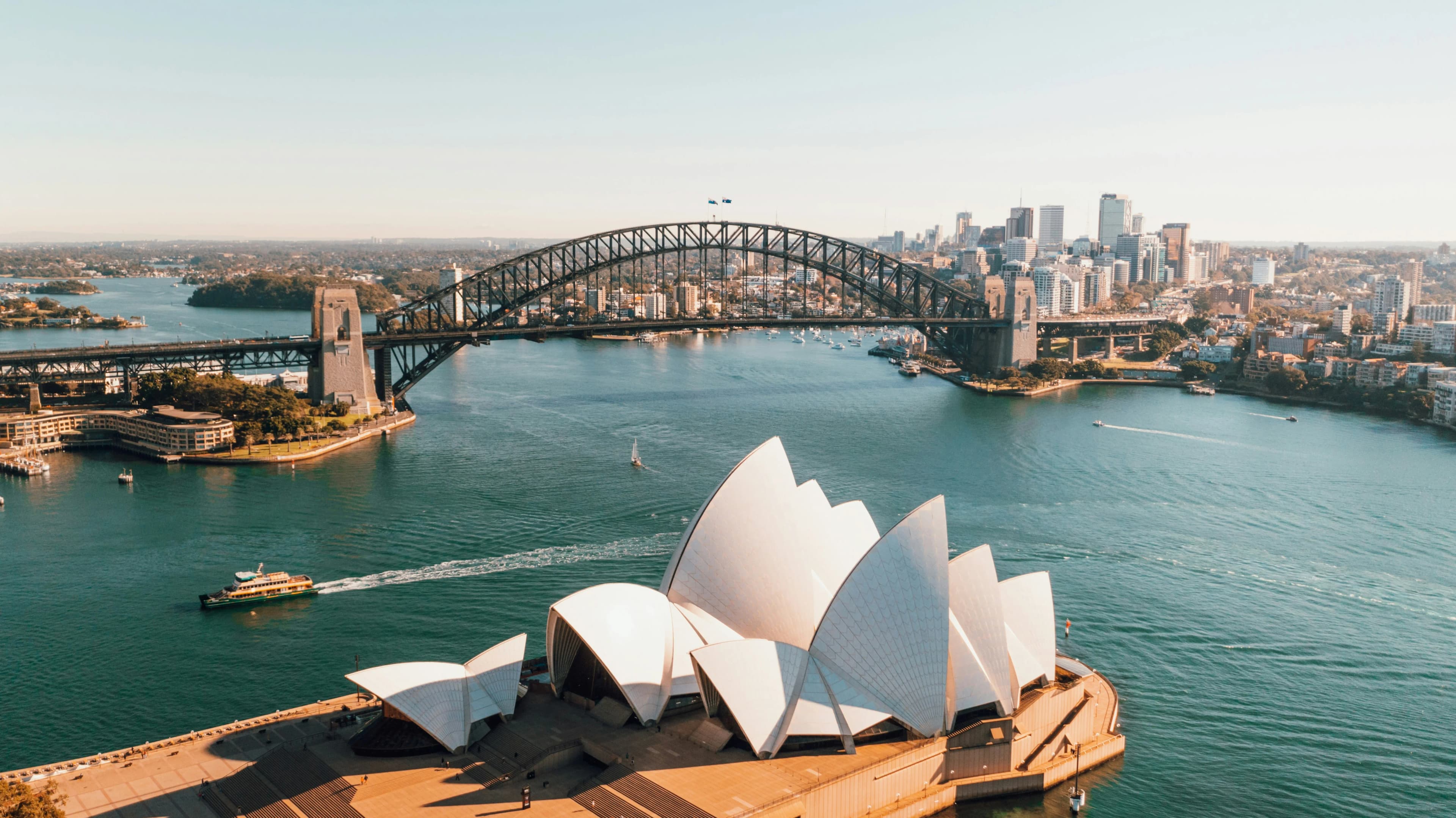
Sydney's luxury hotel cluster is anchored around the Central Business District's harbour-adjacent streets — particularly the precinct framing Circular Quay, where proximity to the Opera House and the Harbour Bridge functions as an architectural address in itself. The Rocks district, immediately west of the Quay, offers a denser urban grain with heritage sandstone buildings that provide context for several of the city's more restrained luxury properties. To the east, Potts Point and Double Bay represent a quieter residential tier of the luxury market, preferred by travellers seeking discretion over landmark adjacency. Suites in this zone tend toward larger floor plates and residential configuration.
Melbourne: Southbank and Collins Street Corridor
Melbourne's luxury accommodation is concentrated along Collins Street — historically the city's institutional spine — and the adjacent Southbank precinct overlooking the Yarra River. The city's design literacy is reflected in its hospitality interiors: Melbourne properties consistently demonstrate a more considered approach to material selection and spatial proportion than their counterparts in other Australian cities. The CBD's compact walkability makes it conducive to the kind of extended urban residency that high-end travellers increasingly seek. The inner suburbs of South Yarra and Toorak, while primarily residential, are positioned within easy reach of the city's principal luxury hotel corridor.
Queensland: The Whitsundays and Great Barrier Reef Corridor
The Whitsunday Islands constitute one of the Southern Hemisphere's most geographically compelling luxury hospitality locations. Island resort properties here operate within a framework of marine park regulation that fundamentally shapes their physical footprint and architectural approach — a constraint that has, in several cases, produced genuinely considered spatial outcomes. Hamilton Island and Hayman Island host the region's most architecturally prominent properties. For travellers whose primary interest is reef access combined with accommodation of consequence, this corridor is without parallel in the Australian context.
The Northern Territory: Uluru and the Red Centre
The accommodation landscape surrounding Uluru — a geologically singular sandstone formation of profound cultural significance to the Anangu people — is deliberately limited in scale. The Ayers Rock Resort precinct, operating within a tightly managed tourism zone, houses the region's principal luxury properties. The surrounding landscape is not merely scenic background; it functions as the primary reason for presence, and the most successful suites here are calibrated to frame and acknowledge that environment rather than to compete with it. The silence, light quality, and spatial scale of the Red Centre are experiential conditions that no urban property can replicate.
Western Australia: Margaret River and the Pilbara Coast
Western Australia's luxury accommodation offering has matured considerably in the past decade, driven partly by the state's resource wealth and the associated demand for high-specification hospitality. The Margaret River wine region, approximately three hours south of Perth, hosts a cluster of small luxury retreats operating within a pastoral and coastal landscape of notable restraint. Perth's CBD, while less architecturally distinguished than Sydney or Melbourne, contains a small number of suite-level properties that serve the state's corporate and high-net-worth leisure market.
When to Visit Australia for Luxury Travel
Australia's continental scale means that optimal travel timing is heavily region-dependent. The country straddles subtropical and temperate climate zones, and experienced travellers plan itineraries accordingly rather than applying a single seasonal logic to the entire country.
For Sydney and Melbourne, the autumn months of March through May represent the most comfortable period for urban stays: temperatures are moderate, rainfall is manageable, and the summer tourist concentration has dissipated. Spring — September through November — offers comparable conditions. The summer months of December through February bring heat and higher occupancy to both cities, with New Year's Eve in Sydney commanding significant advance planning given the harbour fireworks event's international profile.
Queensland's reef corridor operates on a different seasonal axis. The dry season, running from approximately May through October, represents the preferred window for Great Barrier Reef access: water visibility is at its clearest, and the wet season's cyclone risk is absent. Humidity is reduced and temperatures are tolerable rather than oppressive. The summer wet season, while producing dramatic landscape conditions, brings marine stinger warnings that restrict open-water access at many reef locations.
The Northern Territory's Red Centre is best approached during the Australian winter, between May and August. Daytime temperatures are comfortable for landscape exploration, and the night temperatures — which can drop significantly — provide a counterpoint that many travellers find unexpectedly compelling. Summer in the Red Centre involves temperatures that regularly exceed 40°C and is not recommended for extended outdoor engagement.
Key events of relevance to luxury travellers include the Melbourne Cup Carnival in November, which drives significant demand for Melbourne's top-tier accommodation; the Australian Open tennis championship in Melbourne each January; and the Sydney to Hobart Yacht Race, which generates considerable activity in both cities around the Christmas period.
Understanding Australian Luxury Hotel Classifications
Australia does not operate a formal national designation equivalent to France's Palace classification or the United Kingdom's Forbes Travel Guide star system as a regulatory framework. The country's hotel rating system, historically administered through various state tourism bodies, has been progressively standardised under a national framework, but the five-star designation remains the practical ceiling in common usage.
In practice, the meaningful distinction within Australia's luxury tier is between internationally affiliated five-star properties — those operating under major global luxury brands with standardised service protocols — and independently positioned properties that make design and locality their primary differentiators. The latter category, while smaller in number, frequently offers the more architecturally resolved and spatially generous accommodation experiences. Australia's most considered luxury retreats often operate outside formal classification frameworks entirely, relying on reputation and word-of-mouth within the high-net-worth traveller community.
Some Australian properties have sought and received recognition through international frameworks including Forbes Travel Guide and the Leading Hotels of the World membership. These affiliations provide a degree of internationally legible signalling for travellers who rely on such frameworks for initial screening.
How to Choose the Best Suite in Australia
Suite selection in Australia requires a more deliberate geographic commitment than in a compact European city context. The distances between Australia's principal luxury destinations are significant: Sydney to Uluru is approximately 2,800 kilometres by air, and Melbourne to the Whitsundays involves a similar journey. The first consequential decision is therefore not which suite to book, but which region's experiential logic aligns with the purpose of the visit.
For travellers prioritising urban cultural engagement — galleries, restaurants, architecture — Sydney and Melbourne represent the appropriate base. For marine environment and reef access, the Queensland corridor is the logical choice. For landscape immersion of a singular and unrepeatable character, the Northern Territory or the remote Western Australian coast offer conditions unavailable elsewhere in the world.
Within any given region, suite selection should be weighted toward properties that demonstrate a clear spatial relationship to their setting. In Sydney, a suite with direct harbour sightlines commands a fundamentally different experience than an equivalent interior room at the same property. In the Red Centre, the orientation of the suite toward the formation at dawn — when light conditions are most architecturally significant — is a practical consideration worth verifying prior to booking.
Floor plate size, butler service availability, private pool access, and the capacity to arrange bespoke land or marine experiences are the practical metrics by which Australia's top-tier suites can be differentiated at the finest level of resolution.
The Value of a Curated Selection for Australian Luxury Suites
Australia's geographic scale and the relative opacity of its independent luxury retreat sector make curation particularly valuable in this context. The country's finest accommodation is not always the most prominently marketed. Several of the most spatially resolved and experientially distinctive properties operate with minimal promotional infrastructure, relying on established referral networks rather than broad digital visibility.
A curated platform removes the research burden inherent in navigating a vast and geographically fragmented market. Rather than cross-referencing aggregator listings across six states and two territories, the discerning traveller benefits from a pre-screened selection in which each property has been assessed against consistent criteria of spatial quality, service standard, and positional integrity. La Suite's curated selection of Australian luxury suites applies precisely this methodology — prioritising properties where the accommodation itself constitutes a considered experience rather than a functional prerequisite for the destination.
Frequently Asked Questions About Luxury Hotel Suites in Australia
What is the best time of year to stay in a luxury suite in Sydney?
March through May and September through November offer the most temperate conditions for a Sydney luxury stay, with moderate temperatures and reduced peak-season occupancy pressure. New Year's Eve represents the single highest-demand period and requires advance planning of six months or more for harbour-facing suites.
Which Australian city has the most architecturally distinguished luxury hotel interiors?
Melbourne is generally regarded as Australia's most design-literate city, and this reputation is reflected in the interior quality and material specification of its principal luxury hotels, particularly along the Collins Street corridor and in the Southbank precinct.