


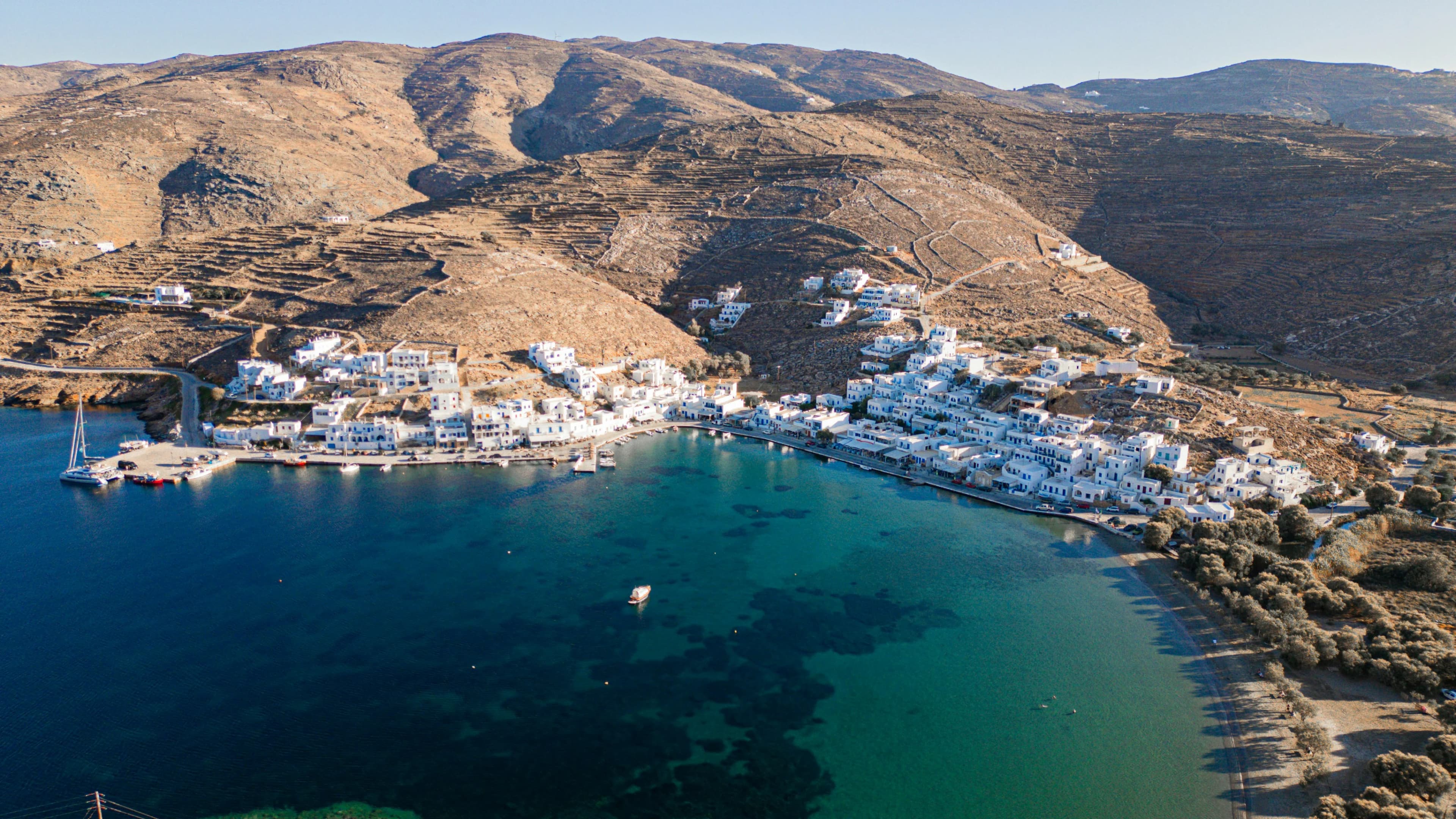
Tinos (island)
Luxury Hotel Suites in Tinos, Greece
Understanding Tinos requires moving beyond the port and into the island's layered geography. Each area carries a distinct architectural and atmospheric identity, and the choice of base shapes the entire experience.
5 hotels available

Featuring air conditioning, the quietly located Aeolis Tinos Suites offers spacious and fully equipped accommodations in Triantaros Village. Facilities include a swimming pool with sun terrace. Megalo

A good location for a relaxing getaway in Agios Fokas, Emerald Tinos is a condo hotel surrounded by views of the garden. The property features a private beach area, fitness center, and private parking

Located in Kardiani and within 1.1 miles of Kalivia Beach, Living Theros Luxury Suites features a terrace, non-smoking rooms, and free WiFi throughout the property. The property is around 10 miles fro

Seamlessly blending in the natural environment, Mr. & Mrs. White Tinos, is a Hotel that combines simplicity and tradition. It features modern esthetics with traditional Cycladic architectural elements

Located in Kionia, a 13-minute walk from Vourni Beach, Odera, Tinos, Autograph Collection has accommodations with a seasonal outdoor swimming pool, free private parking, a fitness center and a garden.
Best Neighbourhoods and Areas to Stay in Tinos
Tinos Town (Chora)
The island's capital is defined by the imposing Church of Panagia Evangelistria, one of the most significant pilgrimage sites in the Orthodox world. The town functions as Tinos's commercial and cultural centre, with a harbour front that sees regular ferry traffic and a density of cafés, restaurants, and galleries concentrated in the streets behind. For travellers who prefer proximity to the island's social rhythm — and direct access to the marble-paved lanes of the upper town — Chora remains the practical anchor. Accommodation here tends toward boutique properties embedded in the existing urban fabric.
Pyrgos
Located in the island's northern interior, Pyrgos is the historic centre of Tinos's marble-carving tradition. The village produced some of Greece's most significant sculptors of the 19th and 20th centuries, and that legacy is present at every turn — in the facades, the fountains, the Museum of Marble Crafts, and the School of Fine Arts. Staying in or near Pyrgos places guests within one of the Aegean's most architecturally coherent settlements. The pace is measured, the visual environment is demanding in the best sense, and the surrounding landscape of terraced hills and dovecotes is unlike anything found elsewhere in the Cyclades.
Isternia and the West Coast
Isternia village sits above a working fishing bay — Isternia Bay — connected by a steep road that descends to a narrow beach and a handful of tavernas. The area attracts those seeking a more withdrawn experience, with sweeping views across to Syros and a slower cadence than the port town. Properties here tend to be smaller and more architecturally integrated into the hillside terrain.
Panormos and the Northern Coast
Panormos Bay, on the northern shore, is known for its protected anchorage and a small cluster of seafood restaurants along the waterfront. The bay is a natural stop for sailing itineraries moving through the Cyclades, and the surrounding landscape — with the Tsiknias mountain ridge as backdrop — provides a grounding visual scale. Accommodation options are limited and tend to be correspondingly exclusive.
Kardiani
Frequently cited by architects and design professionals as one of the most intact traditional villages in the Cyclades, Kardiani is built into a steep hillside overlooking the sea. Its dense, layered stone construction and preserved communal spaces make it a reference point for understanding Cycladic vernacular architecture. Staying near Kardiani is less about amenity access and more about proximity to a living example of the island's spatial intelligence.
When to Visit Tinos
Tinos operates on a different seasonal logic than Mykonos or Santorini. Its religious calendar shapes the island's rhythm as much as the summer sun, and the shoulder seasons here carry genuine appeal rather than compromise.
April to June represents the most architecturally legible period to visit. The light is clear and directional, the villages are accessible without the density of high summer, and the surrounding countryside — including the island's network of marble-dusted footpaths — is at its most navigable. The Feast of the Assumption on 15 August brings tens of thousands of pilgrims to Tinos Town, transforming the island entirely. For those interested in the religious and cultural dimension of Tinos, this date is significant; for those seeking seclusion, it requires planning around.
September and October offer a return to quieter conditions with sea temperatures that remain warm through October. The quality of light in early autumn is among the most consistent in the Aegean, and the island's interior villages see almost none of the visitor pressure found in July and August.
Winter on Tinos is lived-in rather than dormant. Local businesses remain open in Chora, the marble workshops in Pyrgos continue, and the island functions as a year-round community. For travellers interested in the island beyond its summer surface, a visit between November and March offers a rare form of access.
Local Luxury Standards in Greece and the Aegean
Greece does not operate a nationally standardised prestige classification equivalent to France's Palace designation. Greek hotels are graded by the Greek National Tourism Organisation (GNTO) on a star scale from one to five, but this system measures facilities and compliance rather than design quality or service calibre. The presence of a five-star classification is a necessary but not sufficient indicator of a genuinely exceptional property.
In the Aegean context, the meaningful distinctions emerge from other signals: architectural integrity relative to the local vernacular, the quality of material finishes (particularly relevant in a marble-producing island like Tinos), the ratio of surface area to guest capacity, and the coherence of the service model. Properties that have achieved recognition through architectural awards or inclusion in curated collections such as Relais & Châteaux carry more practical meaning for the discerning traveller than star ratings alone.
Tinos specifically has developed a micro-category of design-led accommodation — small properties, often owner-operated, which have prioritised spatial quality and local material use over conventional luxury signifiers. This category is poorly captured by standard classification systems and requires direct curation to identify reliably.
How to Choose the Best Suite in Tinos
The variables that determine suite quality in Tinos differ from those relevant in an urban hotel market. Several considerations are specific to the island context.
Orientation and exposure: The Aegean wind — the meltemi — runs predominantly from the north during summer months. Suites oriented to the south or southwest offer the most consistent outdoor usability during peak season. Properties on the northern coast require an understanding of this dynamic before committing.
Access and mobility: Tinos's interior villages are connected by roads that are narrow and in some cases steep. A suite in Pyrgos or Kardiani implies reliance on a private vehicle for most movement. This is a feature for some travellers and a constraint for others. Establishing the practical logistics of a base before arrival is essential.
Architectural coherence: In a setting as visually specific as Tinos, the relationship between a property and its surrounding built environment matters considerably. Suites within restored traditional structures — stone-vaulted ceilings, marble thresholds, courtyard configurations — offer a spatial quality that purpose-built resort accommodation rarely matches.
Pool versus sea access: Many of Tinos's most architecturally considered properties are village-based and do not offer direct beach access. Private pools, terraces, and the quality of the immediate outdoor space become the primary experiential register. Understanding this trade-off before selecting a property avoids misaligned expectations.
The Value of Curation for Tinos
Tinos presents a particular challenge for travellers accustomed to using standard aggregator platforms. The island's most distinctive properties are frequently small, independently operated, and inconsistently indexed across major booking channels. Some operate with limited online visibility by design; others are categorised in ways that obscure their actual quality level.
The result is a destination where the gap between what is findable through general search and what is genuinely exceptional is wider than in more heavily trafficked markets. A curated approach — one that applies consistent architectural and experiential criteria across the full landscape of available accommodation — surfaces properties that would otherwise require significant independent research to identify. For a destination with Tinos's density of quality within a small geographic footprint, this is not a marginal convenience but a material difference in outcome.
La Suite applies this logic specifically: properties are assessed against criteria that prioritise spatial quality, service coherence, and contextual fit rather than aggregated review volume or brand recognition.
Frequently Asked Questions about Luxury Suites in Tinos
Is Tinos a good destination for luxury travellers?
Tinos has developed a credible luxury accommodation offer concentrated in design-led boutique properties and restored village houses. It appeals specifically to travellers who prioritise architectural quality, cultural depth, and the absence of mass-market infrastructure over the resort amenities found on more developed Cycladic islands.
How does Tinos compare to Mykonos for upscale accommodation?
Tinos offers a more restrained register than Mykonos. Its luxury properties tend to be smaller, more architecturally specific, and embedded in functioning village contexts rather than resort compounds. The service model is typically more intimate and less performance-oriented than Mykonos's established ultra-luxury tier.